
Education & research
TAFE, university, WIL, capstone and applied-research partnership.

Proposed research project
Measuring rural internet in the real world
A proposed project where students and VINCONNECT measure why rural internet behaves differently from one property to the next, so networks can be designed better.
This is a proposal. Sites, equipment and the research method would be agreed with the education partner.
TAFE, university, WIL, capstone and applied-research partnership.
Equipment, evaluation hardware, licences, service credits and engineering support.
The draft measurement protocol, test modules, data model and QA approach.
The research question
The study would systematically vary and record distance, line of sight, vegetation, terrain, building materials, antenna height and alignment, network topology and power conditions. Outcomes would be measured through throughput, latency, jitter, packet loss, signal quality, availability, recovery time and energy use.
Measure how distance, antenna height, alignment and Fresnel-zone clearance affect received signal quality, useful throughput and link stability.
Quantify the effect of vegetation, metal-clad buildings, terrain and other common rural obstructions against unobstructed baselines.
Run a common test protocol across Starlink, 4G, 5G, available NBN services and other field-testable systems as they become available.
Record weather, seasonal conditions, power state and recovery behaviour to understand performance over time rather than from a single speed test.
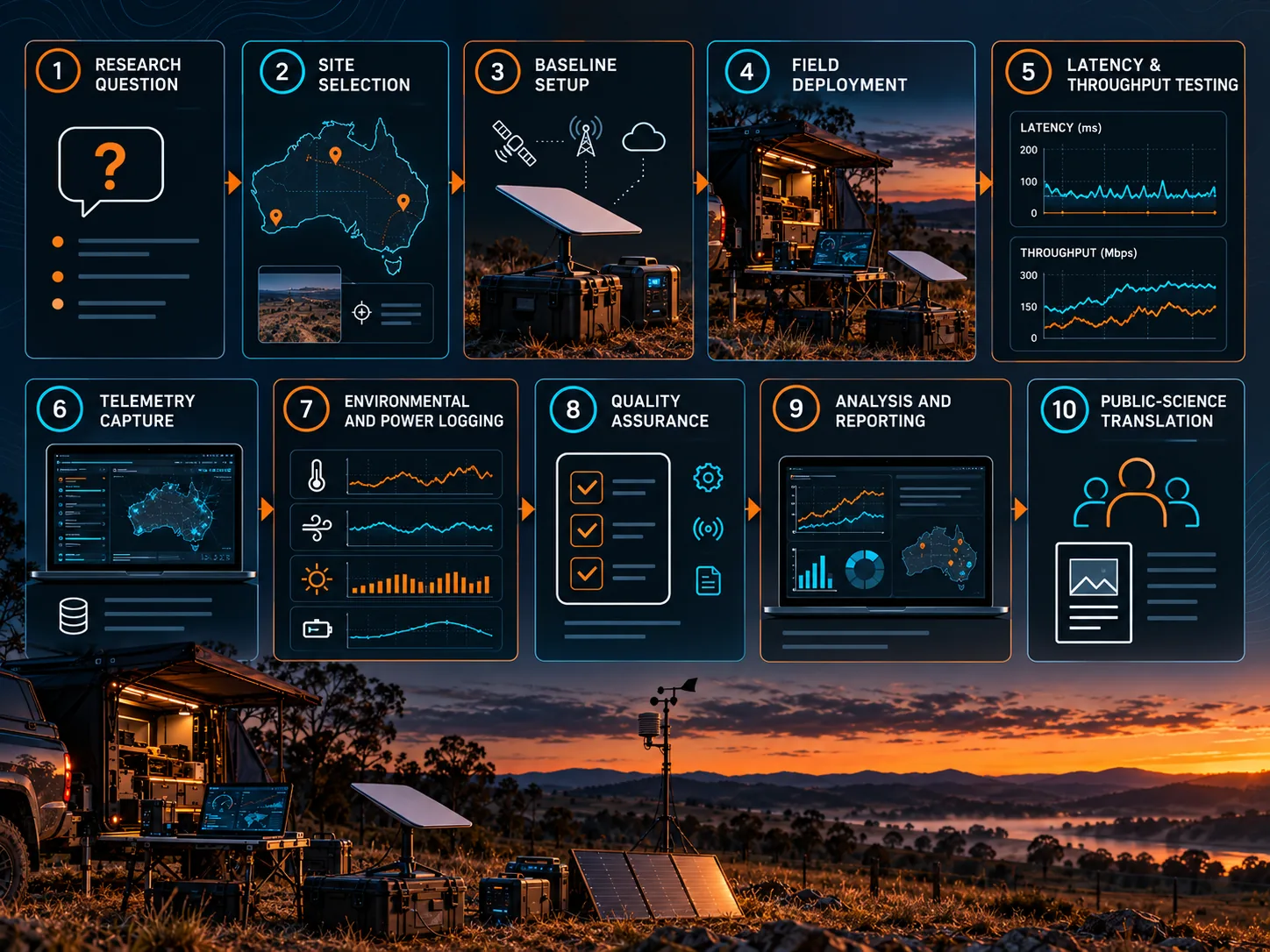
Method
Short-form experiments isolate individual variables. Semi-permanent monitoring nodes then capture operating conditions over six to twelve months so seasonal and time-of-day effects can be separated from one-off observations.
Nominal distances such as 50 m, 100 m, 250 m and 500 m+, subject to site geometry and safe access. Each configuration is repeated against a defined baseline.
The same test sequence is run across available satellite, mobile, fixed and local wireless systems so the results are comparable.
Raspberry Pi or mini-PC nodes schedule tests, timestamp logs and retain raw data so students can reproduce the analysis.
Education partnership
VINCONNECT would act as the industry research partner, providing the field setting, connectivity hardware, installation capability and EventLink mobile platform. A TAFE, university or other education partner would be invited to co-design the method, supervise student participation, strengthen measurement discipline and guide analysis and publication.
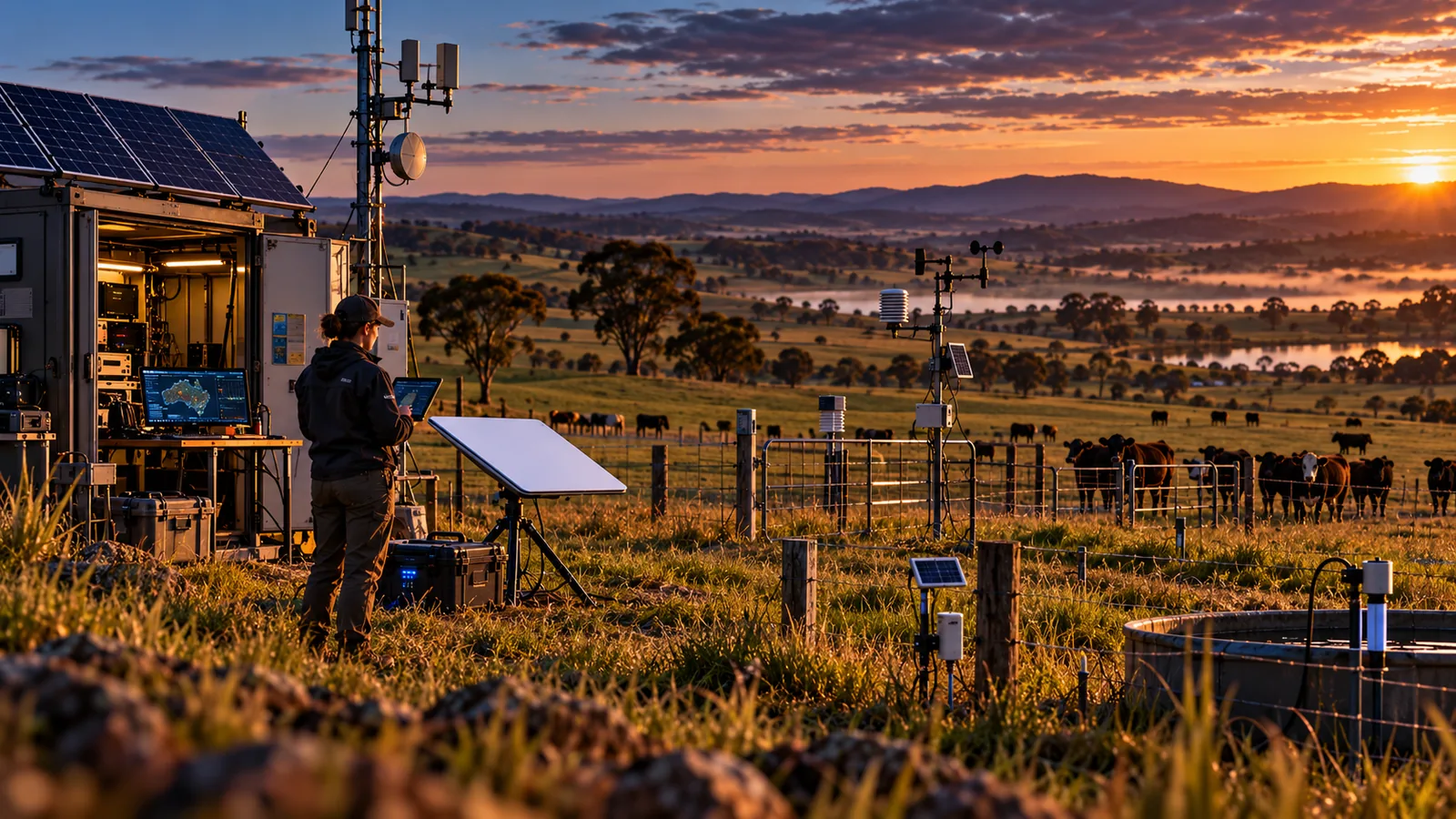
EventLink mobile laboratory
EventLink is proposed as both the mobile research base and the public demonstration platform. Selected experiments can be translated into hands-on science activities: make a prediction, change one variable, measure the result and compare it with the baseline.
Compare clear and obstructed paths and record signal and packet performance.
Compare throughput with latency, jitter and packet loss.
Move a directional radio through controlled angle changes and plot the response.
EventLink is a proposed 2026–27 pilot. No research has been done yet, and no partner is confirmed.
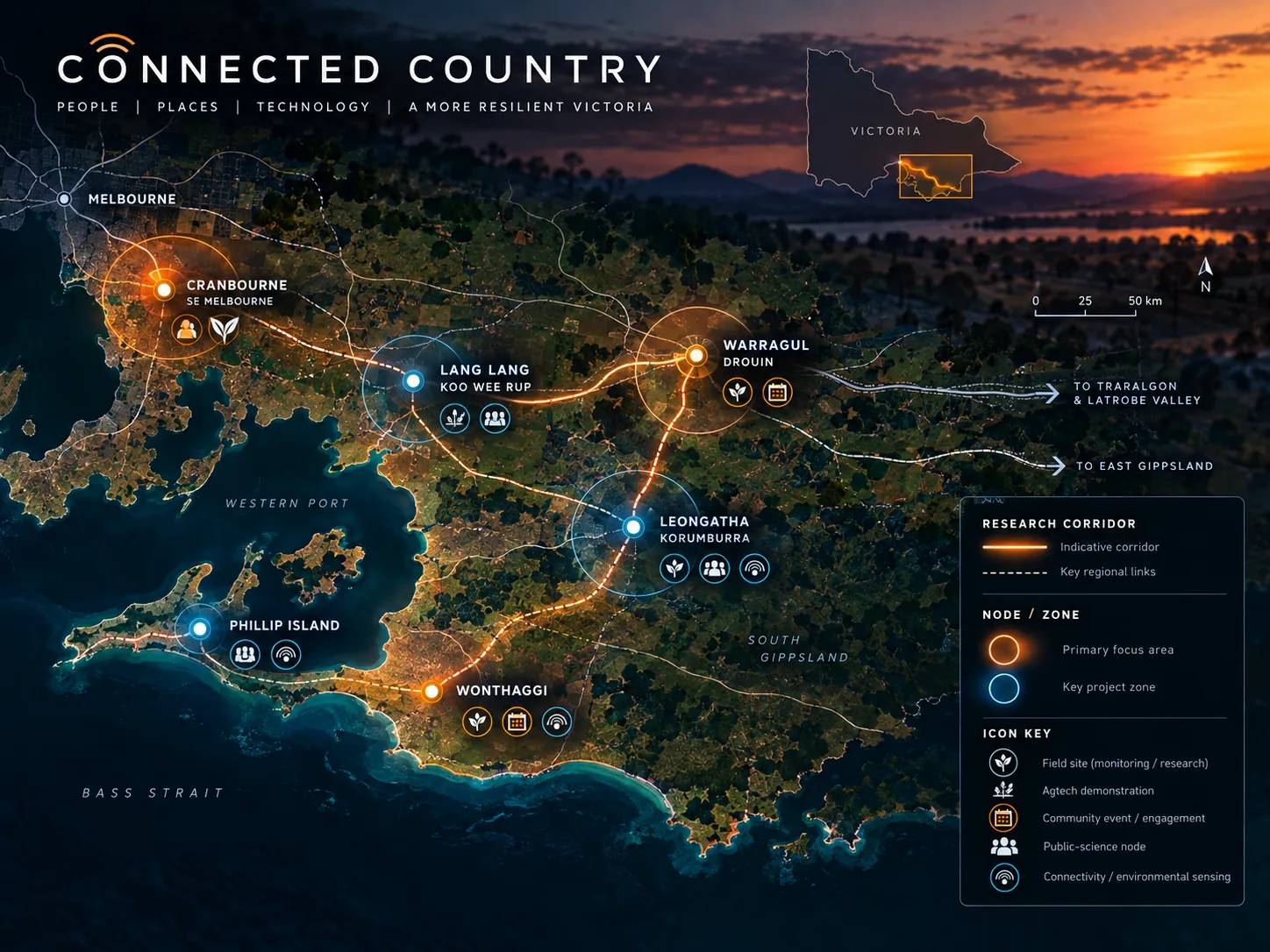
Field region
Planning covers Gippsland, including the Cranbourne, Lang Lang, Warragul/Drouin and Wonthaggi/South Gippsland area. Final sites depend on landholder permission and what each site can test.
Longer-term pathway
A separate one-to-three-year stream could seek suitable partner or government-supported land for repeatable ag-tech, environmental sensing, renewable-energy and communications-resilience experiments. The current proposal keeps that as future scope so the first project remains focused on connectivity science, student learning and public engagement.
Collaboration request
We're looking for an education or research partner. On the first call we'd check the fit, pick a few first-year experiments, list any equipment gaps and decide whether to apply for a grant together.